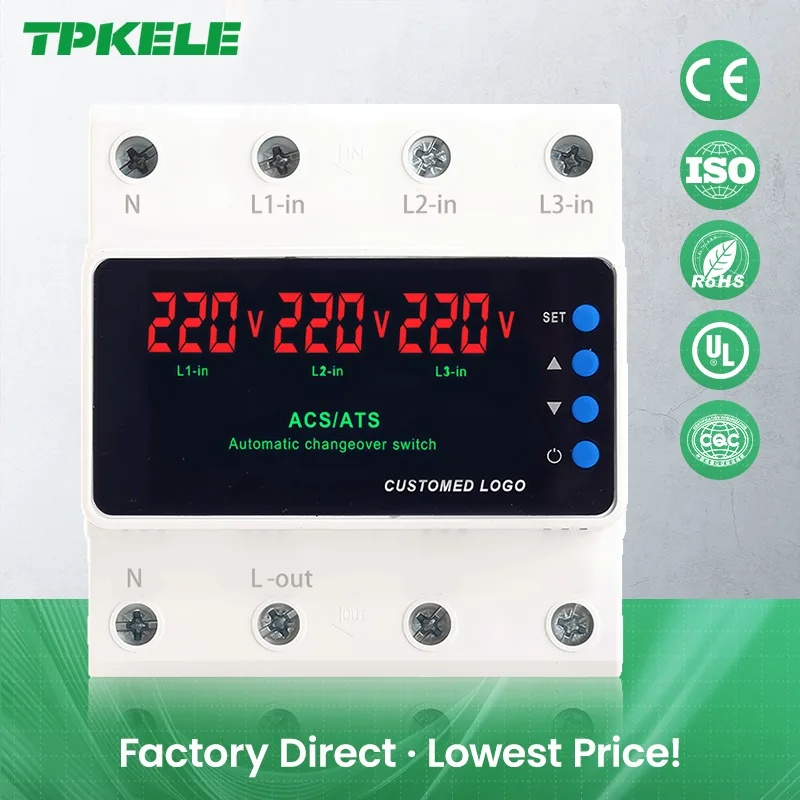
Voltage Protector
STATS-03 Voltage Protector
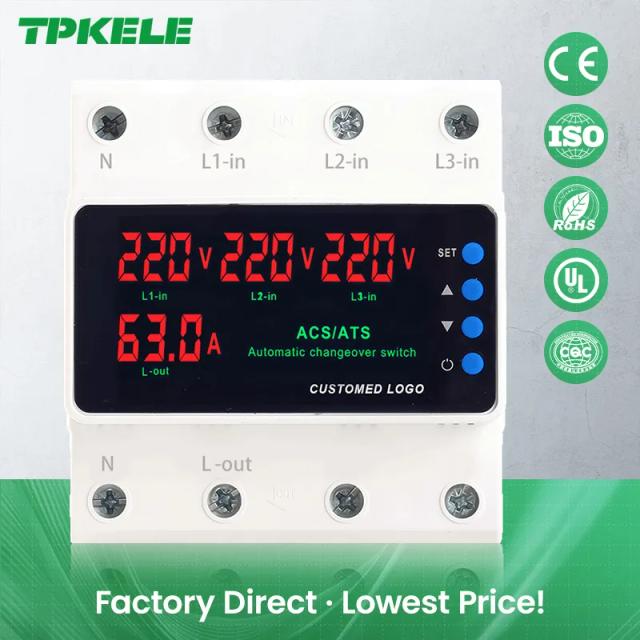
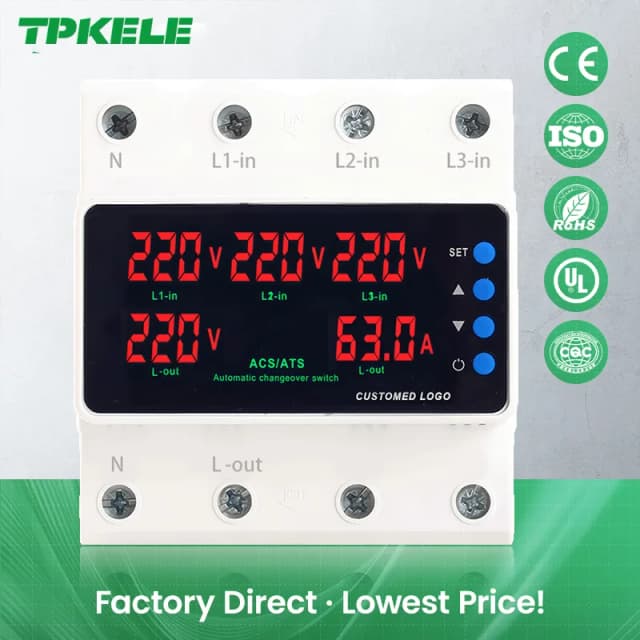
TPKELE STATS-03 is a 3-input automatic transfer switch with over/under voltage and over-current protection. A triple digital display shows L1 / L2 / L3 input voltages, and priority switching (L1 → L2 → L3, customizable) keeps loads supplied from the first healthy source — ideal for CNC machinery, server rooms and solar-grid hybrid systems.
Key Features
- 3-way priority switching (L1 → L2 → L3, customizable)
- Triple display — L1 / L2 / L3 input voltage
- Over / under voltage + over-current protection
- Switching response time < 0.2s
- 35mm DIN-rail mounting
Need full datasheet, drawing or certificates for tender?
Typical Applications
Technical Specifications
| Product Model | STATS-03 |
|---|---|
| Product Type | 3-Input Automatic Transfer Switch with Triple Voltage Display |
| Rated Supply Voltage | AC 3×220V (N-L1/L2/L3) |
| Rated Frequency | 40 / 50 / 60 / 70Hz |
| Over-Voltage Protection Range | AC 130–300V |
| Under-Voltage Protection Range | AC 80–210V |
| Over-Current Protection Range | 1–63A / 1–80A / 1–100A (per rated model) |
| Rated Working Current | 63A / 80A / 100A (Optional) |
| Voltage Accuracy | <1% |
| Display Mode | Triple Digital Display — L1 / L2 / L3 Input Voltage only |
| Priority Switching Sequence | L1 → L2 → L3 (Customizable) |
| Startup Delay Time | 1–600s (Adjustable) |
| Auto-Recovery Delay Time | 1–600s (Adjustable) |
| Switching Response Time | <0.2s |
| Installation | 35mm DIN Rail |
| Housing Material | Flame-Retardant PC (UL94 V-0) |
| Mechanical Life | ≥10,000 Cycles |
| Operating Temperature | -25°C to +50°C |
| Relative Humidity | ≤50% at 40°C (Non-Condensing) |
| Core Functions | 3-Way Priority Switching, Over/Under Voltage Protection, Over-Current Protection, Triple Input Voltage Monitoring |
| Application | CNC Machinery, Server Rooms, Generator-Backed Retail, Solar-Grid Hybrid Systems |
| Conformity | CE marking, RoHS compliant |
Certifications & Standards
Verified to international standards for global tenders
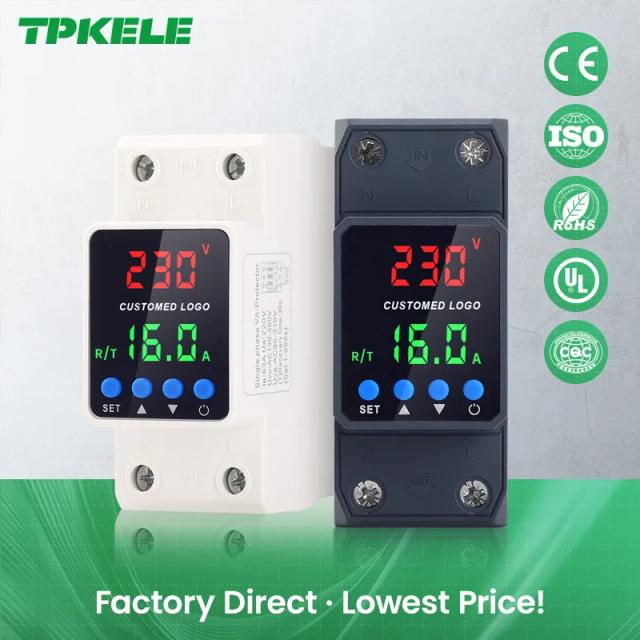
OEM / ODM Available
Private label this Voltage Protector for your brand
Logo, color housing, packaging and certificate documentation tailored to distributor and brand-owner programs.
- Custom logo printing on housing and packaging
- Color housing variants for product line differentiation
- Private-label catalogs and datasheet customization
- Project-spec drawings, single-line diagrams and labels
- Container-load supply with export documentation
- Sample preparation within 5–10 working days
Frequently Asked Questions
When should I install a voltage protector?
Voltage protectors are recommended where mains supply is unstable or where sensitive appliances such as refrigerators, air conditioners and electronics need protection from voltage fluctuations and phase-loss events.
Does the voltage protector reset automatically?
Yes — after the mains voltage returns to a safe range, the protector reconnects the load automatically after a configurable delay (typically 5–600s).
Do you have three-phase models with phase-loss protection?
Yes, our three-phase voltage protectors detect over/under voltage on each phase, plus phase loss and phase sequence errors.
What is the difference between a voltage protector and a surge protector (SPD)?
A voltage protector disconnects loads during sustained over-voltage or under-voltage conditions (lasting seconds or longer), protecting against brownouts and voltage swings. A surge protector (SPD) handles transient voltage spikes lasting microseconds, caused by lightning or switching events. For complete protection, use both: install an AC SPD at the distribution board incoming supply and voltage protectors on sensitive branch circuits. View our AC SPD series for surge protection solutions.
What is the difference between a voltage protector and a voltage stabilizer?
A voltage protector disconnects the load when voltage goes outside safe limits and reconnects automatically when voltage returns to normal. A voltage stabilizer (AVR) continuously adjusts output voltage to maintain a steady level regardless of input fluctuations. Voltage protectors are simpler, more affordable and suitable where occasional disconnection is acceptable; stabilizers are used where continuous operation is critical (medical equipment, data centers).
Can I use a voltage protector with an automatic transfer switch (ATS)?
Yes — voltage protectors are commonly installed downstream of an ATS to protect loads from voltage fluctuations when switching between mains and generator supply. This combination is standard in hospitals, data centers and commercial buildings with backup power. Install the voltage protector after the ATS output, and size it to match the load current. View our ATS series for dual-power backup solutions.
Do I need a voltage protector if I already have an AC MCB installed?
Yes — AC MCBs provide overload and short-circuit protection but do not protect against sustained over-voltage or under-voltage. In markets with unstable grid quality, the standard protection layout combines an upstream AC MCB (for overcurrent faults) with a downstream voltage protector (for voltage quality). This protects sensitive appliances like refrigerators, air conditioners and electronics from both fault currents and voltage swings.
What voltage levels trigger the voltage protector to disconnect?
TPKELE voltage protectors have adjustable trip thresholds. For 230V single-phase systems, typical factory settings are: over-voltage trip at 260V–275V, under-voltage trip at 170V–200V. Three-phase 400V models have corresponding thresholds for each phase. The reconnection delay (typically 30s–300s, adjustable 5s–600s) prevents repeated cycling during short-duration voltage instability.
Need the voltage protector pre-assembled in a box? Build your AC box online.
Configure online →