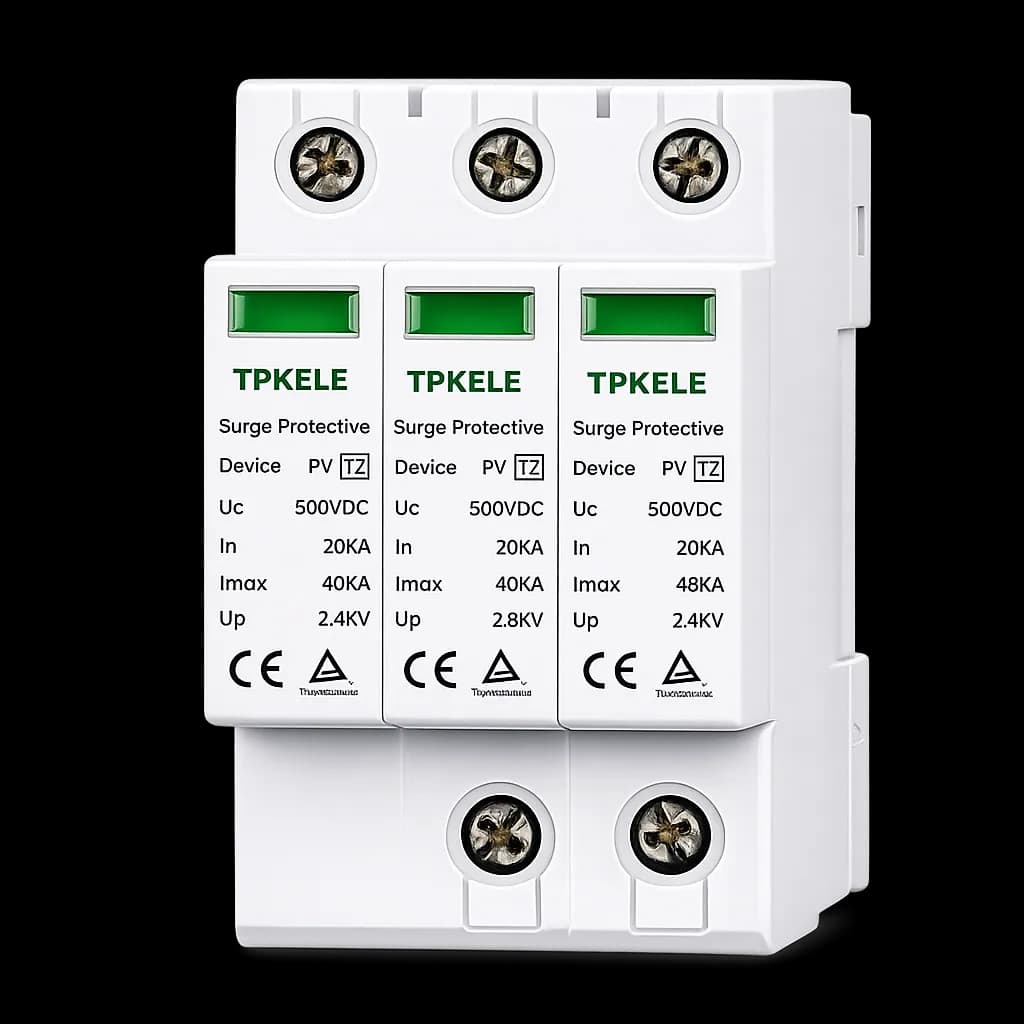
SPD
SPD Manufacturer — AC & DC Solar Surge Protective Devices
TPKELE manufactures surge protective devices (SPDs) for AC distribution and DC photovoltaic systems. Our AC SPD line covers Type 1, Type 2 and Type 1+2 protection per IEC 61643-11; our DC SPD line is built specifically for solar with 600V / 1000V / 1500V Uoc options per IEC 61643-31. Pluggable modules, visual status windows and remote signaling make field service simple — the trusted surge protector choice for solar EPCs, panel builders and distributors.
- AC SPD: Type 1 / Type 2 / Type 1+2 for distribution panels and inverters
- DC SPD: 600V / 1000V / 1500V Uoc for PV combiner boxes and inverter DC sides
- 20kA / 40kA Imax (8/20μs), Up ≤ 1.5 kV
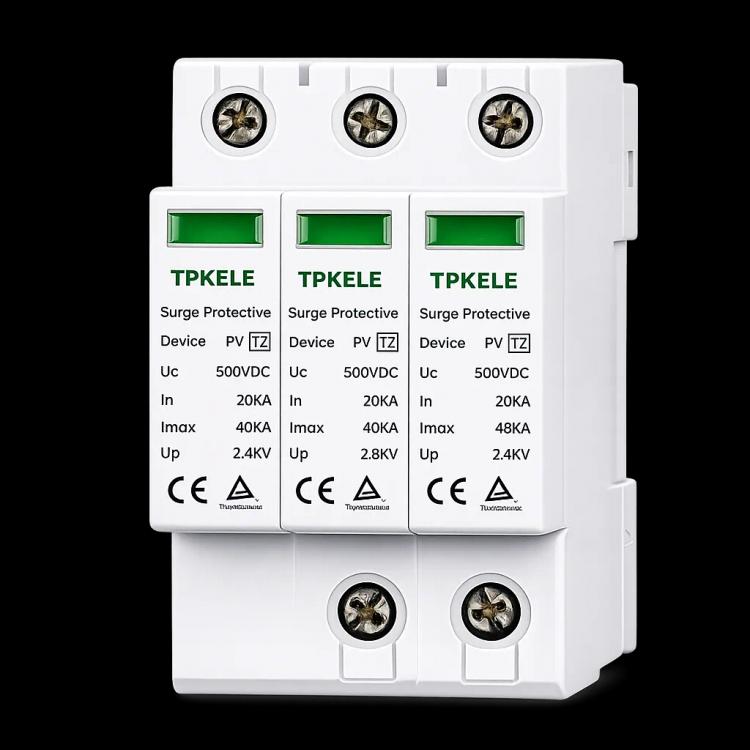
Surge Protective Devices (SPD): Protect Against Lightning and Transient Over-Voltage
A surge protective device (SPD), also called a surge protector or surge arrester, protects electrical equipment from transient over-voltage spikes caused by lightning strikes, switching operations, grid faults or inductive load back-EMF. Unlike circuit breakers that interrupt overcurrent faults, or voltage protectors that disconnect during sustained voltage issues, an SPD clamps or diverts surge energy within nanoseconds — fast enough to protect sensitive electronics, inverters and control systems before damage occurs.
TPKELE manufactures AC SPDs for distribution boards and inverter AC outputs (per IEC 61643-11), and DC SPDs specifically designed for photovoltaic systems (per IEC 61643-31). Both lines feature pluggable varistor modules, visual status indication and optional remote signaling contacts — making field inspection and maintenance simple for solar EPCs, panel builders and distributors.
How SPDs Work: Clamping Transient Surge Energy
SPDs use metal oxide varistors (MOVs), gas discharge tubes (GDTs) or a combination of both to divert surge current away from protected equipment. Under normal voltage, the SPD presents high impedance and does not conduct. When a transient over-voltage spike arrives (e.g. from a nearby lightning strike or inductive switching), the SPD's impedance drops sharply, creating a low-resistance path to ground and clamping the voltage to a safe level (the voltage protection level, Up). Response time is typically under 25 nanoseconds — far faster than any mechanical switch or circuit breaker.
After the surge passes, the SPD returns to its high-impedance state and normal operation resumes. Repeated surge exposure gradually degrades the varistor material; when an SPD reaches end-of-life, its visual status window changes color (typically green → red) and an optional remote signaling contact opens or closes, allowing integration with building management systems (BMS) or alarm panels.
Type 1 SPD vs Type 2 SPD: Which Do You Need?
IEC 61643-11 defines SPD classification by tested impulse waveform and intended location. Understanding the distinction is critical for correct specification:
Type 1 SPD (Class I): Tested with 10/350μs impulse current waveform, which simulates a direct lightning strike current. Type 1 SPDs have high energy absorption capacity (typical Iimp 12.5kA or 25kA per pole) and are installed at the building service entrance (main distribution board incoming supply) where a lightning protection system (LPS, air terminal and down conductors) is present. Type 1 SPDs protect against the portion of lightning current that enters the electrical system via the down conductor. They are mandatory in many regions when an LPS is installed, to prevent side-flashing and internal system damage.
Type 2 SPD (Class II): Tested with 8/20μs impulse current waveform, which represents induced surges and remote lightning effects. Type 2 is the standard SPD for sub-distribution boards, branch circuits and equipment protection. It handles surges caused by switching operations, nearby lightning (not direct strike), grid faults and inductive load back-EMF. Type 2 SPDs are installed at distribution boards throughout the building, downstream of any Type 1 device. Typical In (nominal discharge current) ranges from 5kA to 20kA per pole; Imax (maximum discharge current) from 20kA to 40kA.
Type 1+2 SPD (combined): A single device tested to both Type 1 (10/350μs) and Type 2 (8/20μs) standards. Type 1+2 SPDs are used at the main distribution board when a lightning protection system is present but space or budget does not allow separate Type 1 and Type 2 devices. They provide both direct strike protection and induced surge protection in one unit.
Selection rule: Install Type 1 (or Type 1+2) at the main incomer if an LPS is present. Install Type 2 at all sub-distribution boards and sensitive equipment. If no LPS is present, Type 2 at the main incomer is typically sufficient, though some codes and insurance requirements may specify Type 1+2 regardless.
AC SPD vs DC SPD: Different Systems, Different Requirements
AC and DC surge protective devices are not interchangeable. DC SPDs for photovoltaic systems face unique challenges:
AC SPDs (per IEC 61643-11) are designed for alternating current systems with a natural current zero-crossing every half-cycle (50Hz or 60Hz). This zero-crossing helps extinguish any follow-on current after a surge event. AC SPDs are installed at distribution board incoming supplies, inverter AC outputs and sub-panels. Typical ratings: Uc (maximum continuous operating voltage) 275V / 320V / 385V for 230V / 400V systems, In 5–20kA, Imax 20–40kA.
DC SPDs (per IEC 61643-31) are specifically designed for photovoltaic systems, where DC current has no zero-crossing and arc extinction is much more difficult. DC SPDs must handle the system open-circuit voltage (Uoc) under worst-case conditions (low temperature, high irradiance). They are installed on PV string inputs, combiner box outputs and inverter DC inputs. DC SPDs are rated by Ucpv (maximum continuous DC voltage, e.g. 600V / 1000V / 1200V / 1500V) and must include DC-rated disconnectors or fuses upstream to interrupt follow-on current after a surge. Using an AC SPD on a DC PV system is unsafe and will fail.
Do you need both? Yes — solar PV systems require DC SPDs on the PV array side (strings, combiner boxes, inverter DC input) and AC SPDs on the inverter AC output and building distribution board. Each side faces different surge sources and requires protection matched to the voltage and waveform.
Key SPD Specifications: In, Imax, Up and Uc
Understanding SPD ratings ensures correct selection and coordination:
- Uc (AC) / Ucpv (DC) — Maximum Continuous Operating Voltage: The maximum steady-state voltage the SPD can withstand continuously. For AC systems, Uc must exceed the system nominal voltage (e.g. Uc 275V for 230V system, Uc 385V for 400V system). For DC PV systems, Ucpv must exceed the array open-circuit voltage (Uoc) at minimum temperature — typically Ucpv = 1.2 × Uoc_STC as a safety margin.
- In — Nominal Discharge Current (8/20μs): The current the SPD can discharge repeatedly (typically 15–20 times) without degradation. Common values: 5kA, 10kA, 15kA, 20kA per pole. Higher In means longer service life in high-exposure environments.
- Imax — Maximum Discharge Current (8/20μs): The peak current the SPD can handle in a single surge event and remain functional. Typical Imax values: 20kA, 40kA, 65kA. Imax must exceed the expected worst-case surge current at the installation location.
- Up — Voltage Protection Level: The maximum voltage that appears at the SPD terminals during a surge (the clamping voltage). Lower Up means better protection for sensitive equipment. Typical Up for Type 2 AC SPDs: ≤1.5kV. Equipment withstand voltage (impulse immunity) should exceed Up.
- Response time:Time from surge arrival to SPD conduction. Typical values: <25ns for varistor-based SPDs, ensuring protection before equipment damage.
SPD Installation and Coordination with Circuit Breakers
SPDs are installed on DIN rail inside distribution boards, typically at the incoming supply (for main board protection) or adjacent to sensitive equipment circuits. SPDs connect in parallel (line to ground, line to neutral) — they do not carry load current under normal operation.
Upstream protection: Every SPD must have an upstream overcurrent protective device (AC MCB or fuse) to interrupt follow-on current if the SPD fails short-circuit. The SPD datasheet specifies the maximum backup protection rating (e.g. "protected by 63A gG fuse" or "protected by C32 MCB"). Do not exceed this rating — an oversized MCB may not interrupt fault current fast enough, leading to fire hazard.
Installation location:Install the SPD as close as possible to the equipment it protects, and use short, direct conductors (ideally <0.5m) to minimize lead inductance. Long leads reduce SPD effectiveness by allowing inductive voltage drop during fast-rise surges.
Cascading SPDs:In large installations, use cascaded protection: Type 1 or Type 1+2 at the main incomer, Type 2 at sub-distribution boards. Ensure adequate cable length (typically >10m) or impedance between cascade stages to allow energy sharing and prevent back-feeding.
SPD Maintenance: Visual Status and Remote Signaling
SPDs degrade with repeated surge exposure. TPKELE SPDs feature visual status indication (green window = operational, red window = replace) for quick inspection during routine maintenance. Pluggable cartridge designs allow varistor module replacement without removing the base unit or disconnecting wiring — minimizing downtime.
Selected models include an optional remote signaling contact (dry contact, normally open or normally closed) that changes state when the SPD reaches end-of-life or internal disconnector trips. This contact can be wired to a BMS, SCADA input or alarm panel for centralized monitoring — critical for unmanned sites such as solar farms, telecom cabinets and remote sub-stations.
Complete Your Surge Protection System
SPDs work as part of a layered protection strategy:
Frequently Asked Questions
Which SPD type do I need for a solar PV project?
PV strings, combiner boxes and inverter DC inputs require DC SPDs sized to the system Uoc (600V / 1000V / 1500V). Inverter AC outputs and the building distribution board use AC SPDs (Type 2 standard, Type 1+2 if direct lightning exposure is possible).
What is the difference between Type 1, Type 2 and Type 1+2?
Type 1 (10/350μs waveform) protects against direct lightning strike currents at the building entrance. Type 2 (8/20μs) protects against induced surges downstream. Type 1+2 combines both — used at the main distribution board when a lightning protection system is present.
What does Imax / In mean on an SPD?
In = nominal discharge current (8/20μs) the SPD can pass repeatedly. Imax = maximum one-shot discharge current the SPD can handle once and remain functional. Choose In/Imax based on lightning exposure and project specs.
Are TPKELE SPDs CE certified?
Yes — all SPDs comply with CE, RoHS and IEC 61643-11 (AC) / IEC 61643-31 (DC PV). Test reports are available for project files and tenders.
Do you offer SPDs with remote signaling output?
Yes, selected models include a remote signaling contact (NO/NC) so you can monitor SPD health from a central control system or BMS.
What is the difference between Type 1 SPD and Type 2 SPD?
Type 1 SPDs (tested with 10/350μs impulse current) protect against direct lightning strike currents at the building service entrance. Type 2 SPDs (tested with 8/20μs waveform) protect against induced surges downstream in distribution boards. Type 1 is installed at the main incomer where lightning protection system (LPS) is present; Type 2 is standard for sub-distribution boards. Type 1+2 combined devices are available where both functions are needed at one location. Read our complete guide: Type 1 SPD vs Type 2 SPD selection.
Do I need both AC SPD and DC SPD for a solar PV system?
Yes — solar systems require protection on both DC and AC sides. Install DC SPDs rated for the system open-circuit voltage (Uoc) on PV strings, combiner box outputs and inverter DC inputs. Install AC SPDs (Type 2) on the inverter AC output and the building AC distribution board. DC SPDs must be sized to the PV system voltage (600V / 1000V / 1500V Uoc); AC SPDs are selected based on the AC system voltage (230V / 400V). View our DC SPD series for PV applications.
How do I know when an SPD needs replacement?
TPKELE SPDs feature a visual status window (typically green = OK, red = replace) for quick field inspection. Selected models include a remote signaling contact (dry contact, NO/NC configurable) that changes state when the SPD fails, allowing integration with BMS or alarm systems. Pluggable cartridge designs allow fast field replacement without removing the base unit. Check SPD status during routine maintenance — a failed SPD offers no protection and should be replaced immediately.