What a Circuit Breaker Does
A circuit breaker opens a circuit when a fault condition within its specified protective functions is detected. An MCB provides overcurrent protection against overloads and short circuits, helping limit damage to conductors and connected equipment. An RCBO adds residual-current protection, subject to its rated residual operating current and applicable product standard.
Interrupting a circuit is not the same as protecting the entire electrical installation. Effective protection also depends on conductor sizing, earthing, fault levels, device coordination, and any separately required surge protection. Selection must therefore verify the breaker's ratings against the installation conditions, including the prospective fault current and the applicable AC or DC circuit.
Main Components and Their Functions
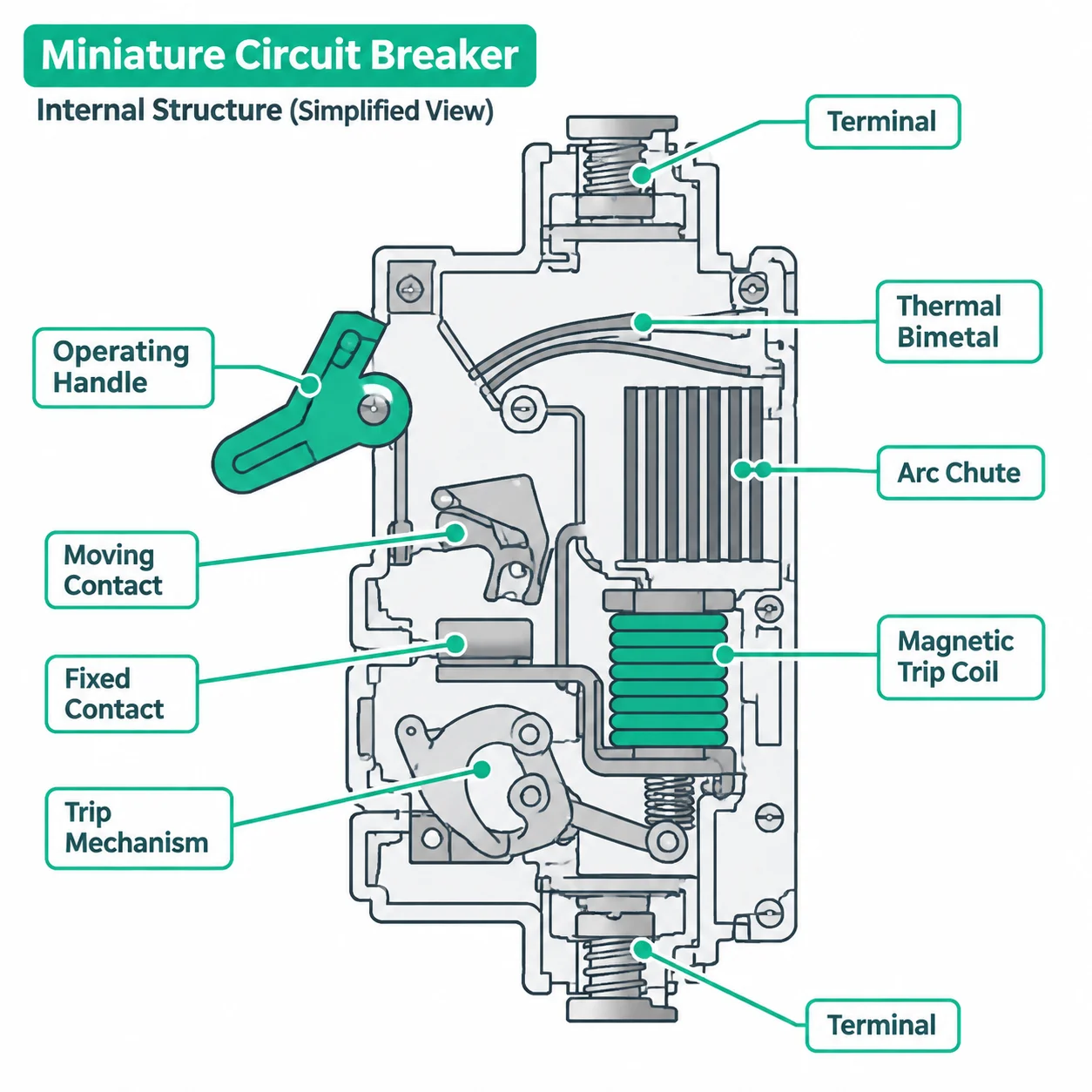
An MCB or RCBO combines switching parts, fault-detection and trip parts, connection points, and an insulating enclosure. Their arrangement and construction vary by product, pole configuration, rated current, and AC or DC application. The component descriptions below are general; confirm construction and operating details against the specific product documentation.
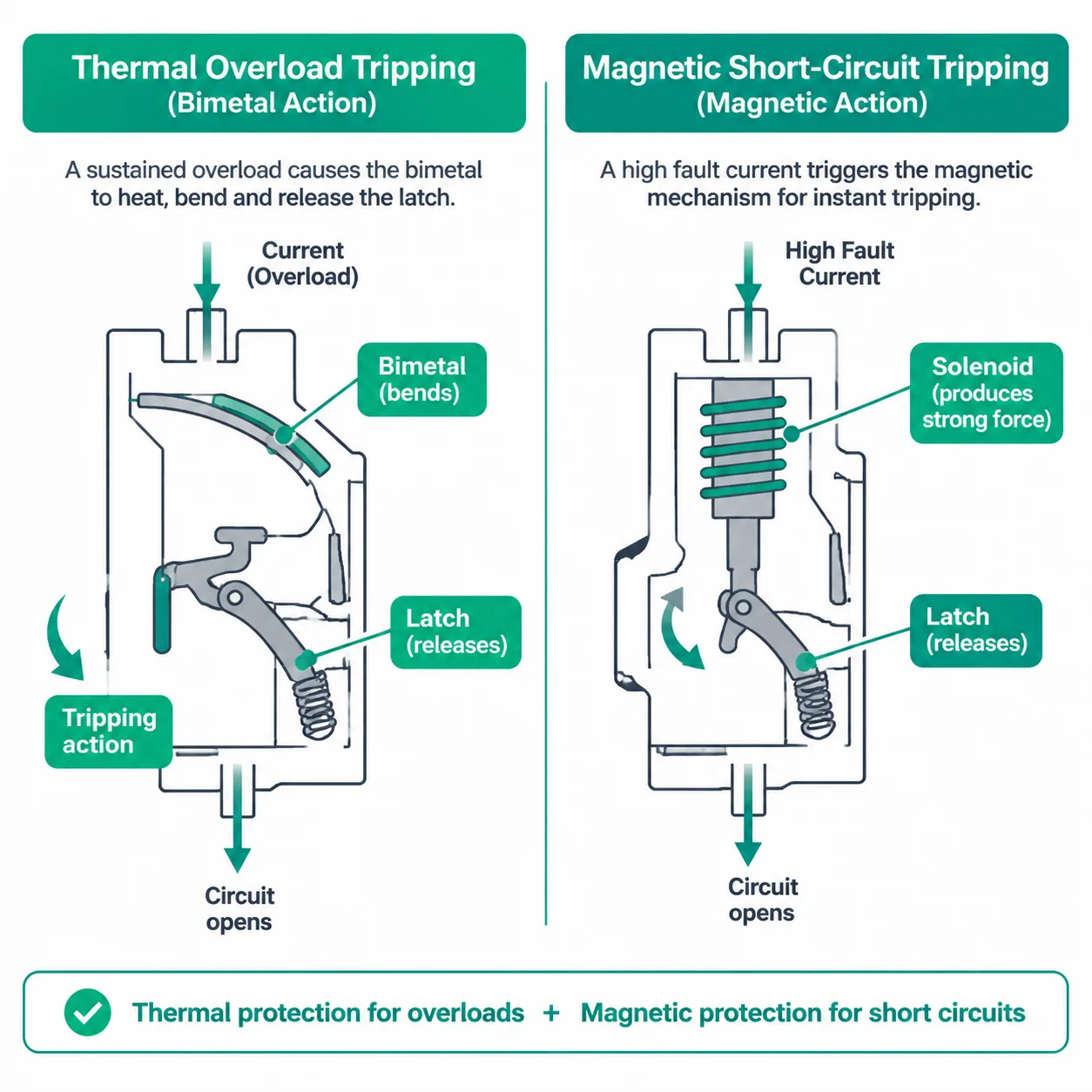
How Thermal and Magnetic Tripping Works
During an overload, current heats the thermal release until it trips; the higher the overload, the shorter the operating time. During a short circuit, a sufficiently high current operates the magnetic release rapidly. Both mechanisms provide overcurrent protection in a thermal-magnetic MCB; an RCBO also provides residual-current protection under IEC 61009-1. The time-current characteristic shows how the overcurrent response changes with current, rather than specifying one fixed trip time. ([library.e.abb.com](https://library.e.abb.com/public/524e819dea1746ef847ad2bc7549c897/9AKK108470A6718_Converting%20from%20Fuses%20to%20MCBs%20Tech%20Guide_DGT.pdf?x-sign=bqzek%2B35i9SA5p8qNASQ2UeEnLFOADsmsmTTezVHSX1dSczFJ9w%2BwDi1reSCNosU&utm_source=openai))
| IEC 60898-1 characteristic | Magnetic trip range | Selection implication |
|---|---|---|
| B | 3–5 × rated current (In) | Lower instantaneous threshold; check against normal inrush. |
| C | 5–10 × In | Allows more inrush than B; verify fault current at the circuit end. |
| D | 10–20 × In | Higher instantaneous threshold; verify both starting current and minimum fault current. |
B, C and D describe magnetic trip bands for AC MCBs to IEC 60898-1; they do not establish selectivity by themselves. For coordination, compare the downstream and upstream devices’ time-current curves at overload currents, including their tolerance bands. In the instantaneous short-circuit region, consult manufacturer coordination data for the specific device combination: two breakers may both trip even when their curve letters differ. Also verify that the selected breaker’s breaking capacity is suitable for the prospective short-circuit current at its installation point. ([legrand.com](https://www.legrand.com/sites/default/files/Documents_PDF_Legrand/Solutions/Power_guide/Power-Guide-Legrand_EX29009.pdf?utm_source=openai))
MCB, RCBO, and RCCB: Functional Differences
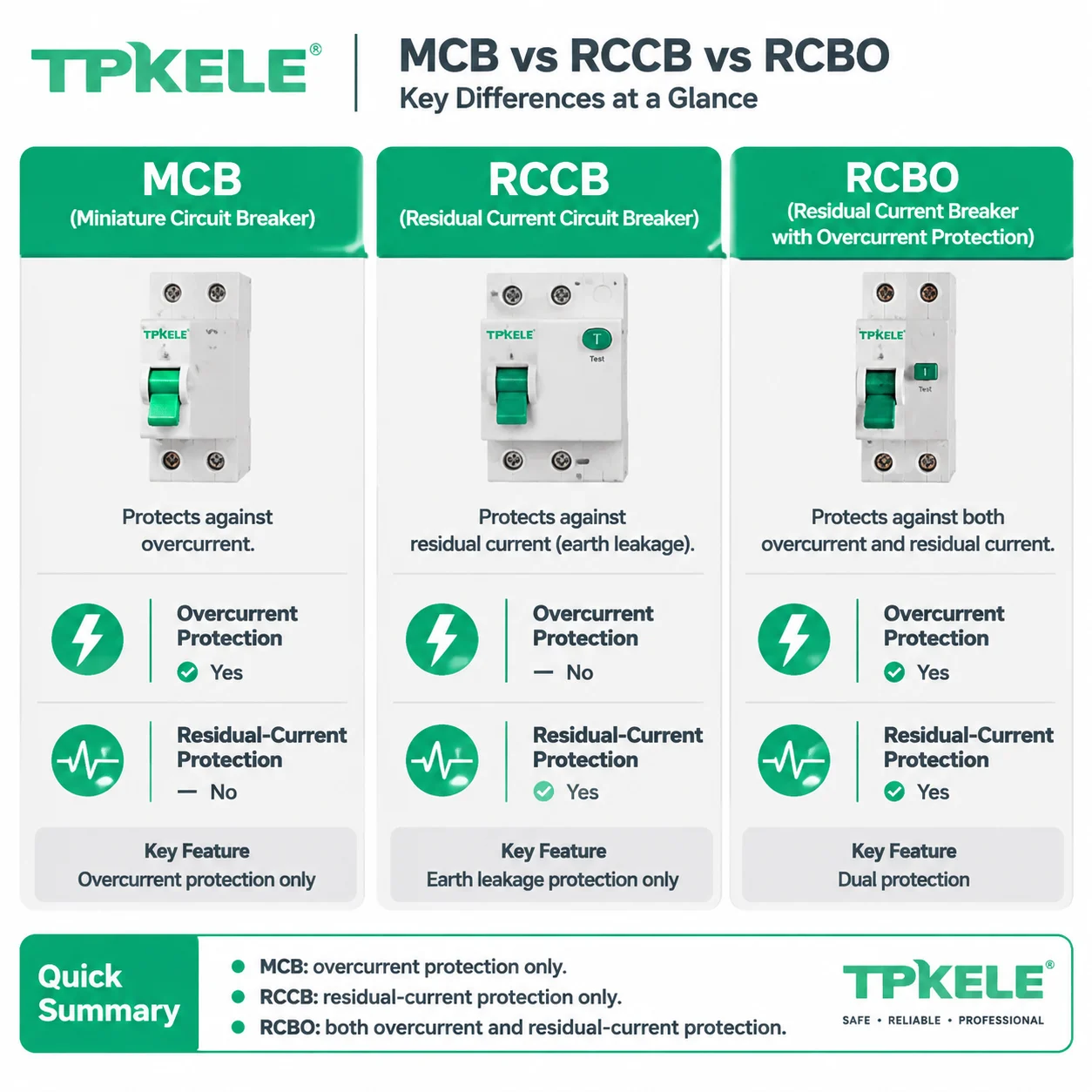
An MCB protects a circuit against overloads and short circuits, but it does not detect residual current. An RCCB detects residual current, but it does not provide overload or short-circuit protection on its own. An RCBO combines both functions in one device, so the distinction matters when specifying protection for an individual circuit.
- For an RCCB installation, identify the associated MCB or fuse and verify coordination against the specific device documentation.
- For an RCBO, compare rated current, short-circuit breaking capacity, rated residual operating current (IΔn), RCD type, and pole configuration.
- Confirm the applicable standard and voltage rating for the specific model; an AC rating does not establish suitability for DC circuits.
AC and DC Breaker Selection Considerations
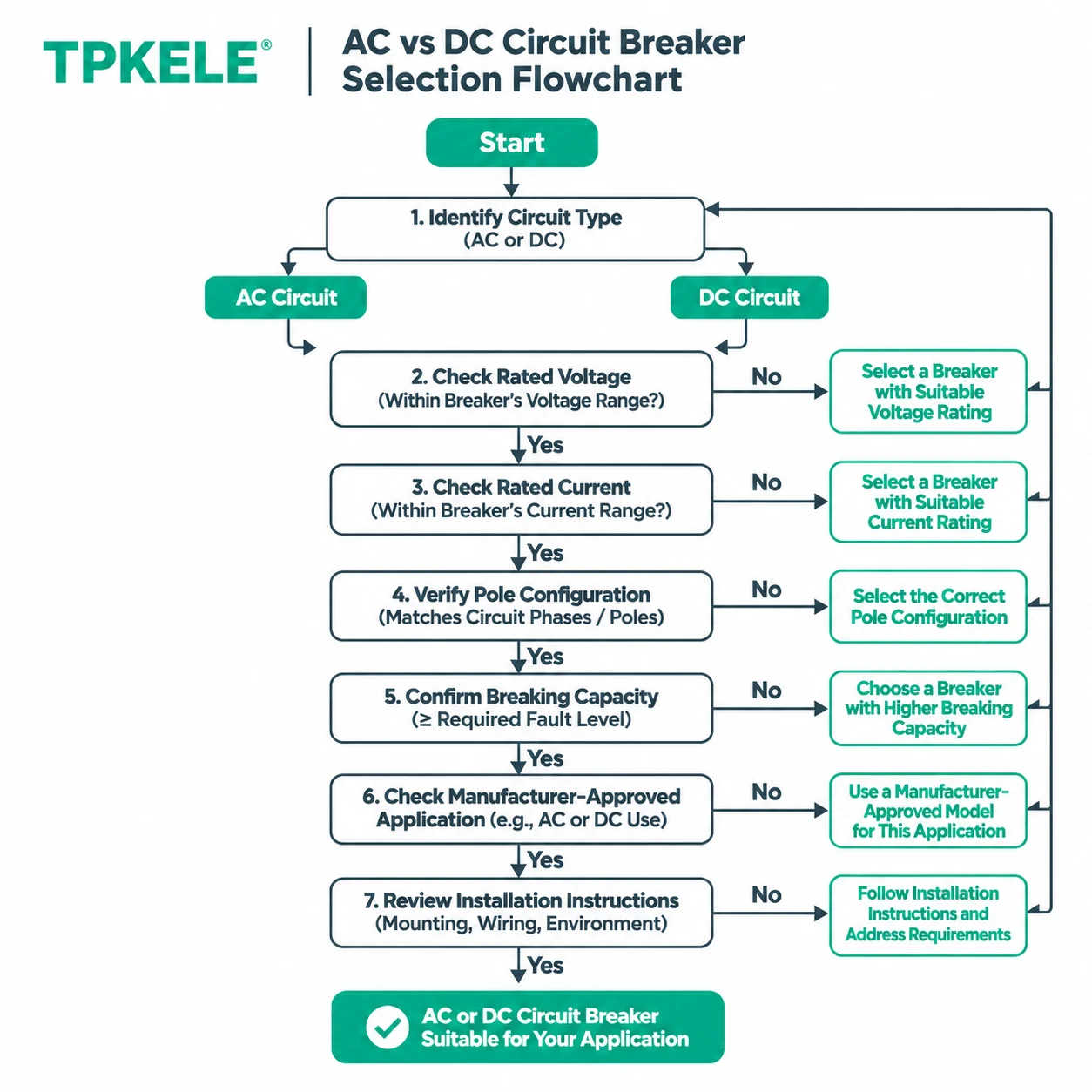
Select a breaker against the electrical conditions at its installation point, not its nominal current alone. Confirm that the rated voltage covers the circuit voltage and that the device is explicitly rated for AC or DC service, as applicable. For an MCB, check the applicable product standard and the model's declared ratings; IEC 60898-1 covers AC applications, while IEC 60898-2 addresses AC and DC applications. For an RCBO, check the declared ratings and applicable standard, such as IEC 61009-1 or AS/NZS 61009.1.
DC arc interruption depends on the device's internal design and the specified circuit connection. Follow the exact model's wiring diagram and instructions for terminal assignment, supply direction where specified, pole connections, and permitted earthing arrangement. Before ordering or installing, verify any rating or connection detail not shown on the device marking against the manufacturer's documentation for that model.
Ratings, Standards, and Verification Before Purchase
Before approving an MCB or RCBO, match the exact catalog number—not just the product family—to the circuit design and destination market. IEC 60898-1 covers circuit breakers for AC overcurrent protection in household and similar installations, while IEC 61009-1 covers RCBOs for household and similar use; Australian and New Zealand projects may specify AS/NZS 61009.1. Check the edition and any national adoption required by the project, then request evidence that applies to the proposed variant. A stated standard or product marking alone does not establish that every rating or configuration in a series has been evaluated. ([webstore.iec.ch](https://webstore.iec.ch/en/publication/62129?utm_source=openai))
- Confirm rated voltage, frequency, current, pole configuration and the applicable short-circuit breaking capacity against the circuit and calculated prospective fault current. For an RCBO, also confirm rated residual operating current and residual-current type.
- Check the time-current characteristic against load inrush and conductor protection requirements. Obtain the manufacturer’s characteristic data for the exact model rather than selecting by a B, C or D marking alone.
- Verify installation limits: ambient-temperature range and derating, mounting orientation, enclosure conditions, terminal conductor sizes, tightening torque and any required supply-side connection. Confirm model-specific suitability where conditions differ from the standard installation instructions.
- For US projects, verify the device’s certification and permitted application under the applicable US standard. UL distinguishes UL 489 circuit breakers used for branch-circuit protection from UL 1077 supplementary protectors, which are not intended to provide that protection. ([ul.com](https://www.ul.com/services/circuit-breaker-and-supplementary-protector-services?utm_source=openai))
- For DC applications, verify the exact model’s DC voltage, breaking capacity, pole-connection requirements and polarity markings in its documentation; do not infer DC suitability from an AC rating. IEC 60898-2 specifies additional requirements for certain breakers suitable for AC and DC operation. ([webstore.iec.ch](https://webstore.iec.ch/en/publication/25675?utm_source=openai))
Explore TPKELE Circuit Protection Products
Review TPKELE product information for AC MCBs, DC MCBs, and RCBOs when matching a device to a circuit or panel design. Compare the published ratings and application details with the supply system, installation conditions, and applicable requirements in your target market. Product configuration and available specifications vary by model.
TPKELE Circuit Protection
Review MCB and RCBO product information
Check product-specific ratings and application details for AC and DC protection devices.
For selection or procurement, provide the required system voltage, pole configuration, rated current, breaking capacity, and application. Confirm device-specific ratings, standards, and suitability with TPKELE before ordering.
Частые вопросы
What breaking capacity should I specify for an MCB?
Specify a rated short-circuit capacity that is not less than the prospective fault current at the installation point, while checking coordination and applicable installation rules. Confirm the exact model's rating and test standard; IEC 60898-1 applies to relevant household and similar AC circuit-breakers.
How do I choose the number of poles for an AC or DC MCB?
Select pole configuration based on the circuit arrangement, conductors that must be switched, and the manufacturer's permitted wiring scheme. For DC applications, verify the device's DC voltage rating, polarity requirements if any, and series-pole instructions for the exact model.
What is the difference between an MCB, an RCCB, and an RCBO?
An MCB provides overcurrent protection, while an RCCB detects residual current and generally requires separate overcurrent protection. An RCBO combines residual-current and overcurrent protection; verify its rated current, residual operating characteristics, breaking capacity, and applicable product standard.
Which certifications should I check when buying circuit breakers for Europe, Australia, or North America?
Check the exact model's applicable conformity documents and product standard, not only a general CE, RCM, or UL mark. Relevant frameworks may include IEC 60898-1 or IEC 61009-1, applicable Australian/New Zealand standards and RCM obligations, or UL 489 where applicable to the device and installation.
Can an AC MCB be used in a DC circuit?
Do not assume an AC-rated breaker is suitable for DC, because DC arcs can be more difficult to extinguish. Use a device explicitly rated for the circuit's DC voltage and current, and follow its pole, polarity, and wiring instructions.
Official References
- IEC 60898-1:2015+AMD1:2019 CSV, Electrical accessories - Circuit-breakers for overcurrent protection for household and similar installations - Part 1: Circuit-breakers for a.c. operation
- IEC 61009-1:2024, Residual current operated circuit-breakers with integral overcurrent protection for household and similar uses (RCBOs) - Part 1: General rules